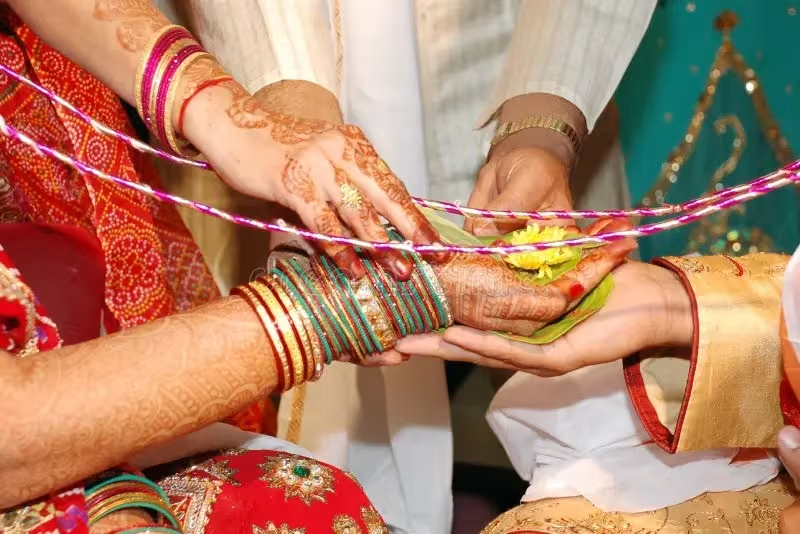
Dowry, the practice of transferring money, goods, property, or valuables from the bride's family to the groom's as a precondition for marriage, remains one of India's most deeply entrenched social evils. What began as voluntary gifts (stridhana) for the bride's security in ancient times has morphed into coercive demands, commodifying women and reinforcing patriarchal control. Despite being illegal for over six decades, dowry drives harassment, violence, and deaths, exposing the gap between law and societal norms.
Historical Evolution
In Vedic and ancient texts, stridhana referred to gifts given voluntarily to the bride for her independence. Over centuries, especially during medieval and colonial eras, economic shifts and restricted women's inheritance rights turned it into mandatory payments. By the mid-20th century, reformers highlighted its dangers, leading to the Dowry Prohibition Act, 1961, which banned giving, taking, or demanding dowry.
Yet, the practice persists, often disguised as "gifts" or wedding expenses. As Mahatma Gandhi powerfully stated: "Any young man who makes dowry a condition for marriage discredits his education and his country."
Causes and Societal Roots
Dowry thrives due to:
- Patriarchal Attitudes — Viewing daughters as burdens and sons as assets.
- Greed and Consumerism — Demands escalate with the groom's perceived "market value" (education, job).
- Social Pressure — Families fear stigma or poorer matches without dowry.
- Gender Imbalance and Inequality — Skewed sex ratios and limited women's empowerment fuel demands.
Social reformers have long condemned such mindsets. Raja Ram Mohan Roy, through his broader campaigns against practices degrading women (like sati), laid the foundation for challenging customs that reduce women to transactions. Similarly, Swami Vivekananda critiqued materialism in traditions, arguing that practices like dowry hinder both spiritual and social progress.
Statistics: A Grim Reality
Recent data from the National Crime Records Bureau (NCRB) underscores the scale:
| Year | Cases under Dowry Prohibition Act | Dowry Deaths Reported |
|---|---|---|
| 2021 | 13,568 | ~6,800 |
| 2022 | 13,479 | 6,450 |
| 2023 | 15,489 (14% rise from previous year) | 6,156 |
- Uttar Pradesh recorded the highest numbers in 2023 (7,151 cases under the Act; 2,122 dowry deaths), followed by Bihar.
- The National Commission for Women (NCW) received over 4,383 dowry harassment complaints in 2024–2025 (partial data).
From The Hindu (October 2025): "Cases registered under dowry-related crimes saw a 14% increase in 2023, with more than 15,000 cases... and over 6,100 deaths reported."
NDTV (October 2025): "A total of 6,156 people lost their lives in dowry death cases in 2023."
Consequences: Violence and Human Tragedy
Dowry leads to:
- Harassment and Abuse — Emotional and physical torture, often escalating post-marriage.
- Dowry Deaths — Murders or forced suicides, frequently staged as kitchen accidents.
- Financial Devastation — Bride families incur lifelong debt.
- Broader Inequality — Contributes to female foeticide and women's subjugation.
Recent cases highlight the ongoing crisis:
- Nikki Bhati Case (August 2025, Noida) — A young woman died from burns allegedly due to dowry harassment; in-laws arrested (The Hindu coverage).
- Persistent NCW complaints in 2025 show thousands of women facing torture over unmet demands.
Modern activist Shalu Nigam has described the reality starkly: "The culture of senseless violence with impunity is growing... The lives of young women are simply of no significant value."
Legal Framework and Challenges
Key provisions:
- Dowry Prohibition Act, 1961 (amended 1984–86): Criminalizes giving, taking, or demanding dowry (minimum 5 years imprisonment).
- IPC Section 498A: Cruelty by husband or relatives.
- Section 304B: Presumes dowry death if unnatural death occurs within 7 years of marriage with proven harassment.
Enforcement remains weak: conviction rates hover around 20–30%, trials drag on, and social stigma deters reporting. Misuse allegations further complicate justice delivery.
Path to Eradication
Eliminating dowry requires sustained efforts:
- Education and Empowerment — Prioritizing girls' schooling and economic independence.
- Awareness Campaigns — Government schemes, NGOs, and media drives to normalize dowry-free marriages.
- Strict Enforcement — Fast-track courts, sensitive policing, and higher conviction rates.
- Cultural Shift — Promoting gender equality, equal inheritance, and community pledges against dowry.
Dowry is not merely a crime but a symptom of deep-seated inequality. As statistics and daily tragedies reveal, it continues to claim lives and dignity. True progress demands collective resolve—rejecting demands, supporting victims, and building a society where marriages are founded on mutual respect, not financial transaction. Only through education, enforcement, and empathy can this social evil be uprooted.
Comments