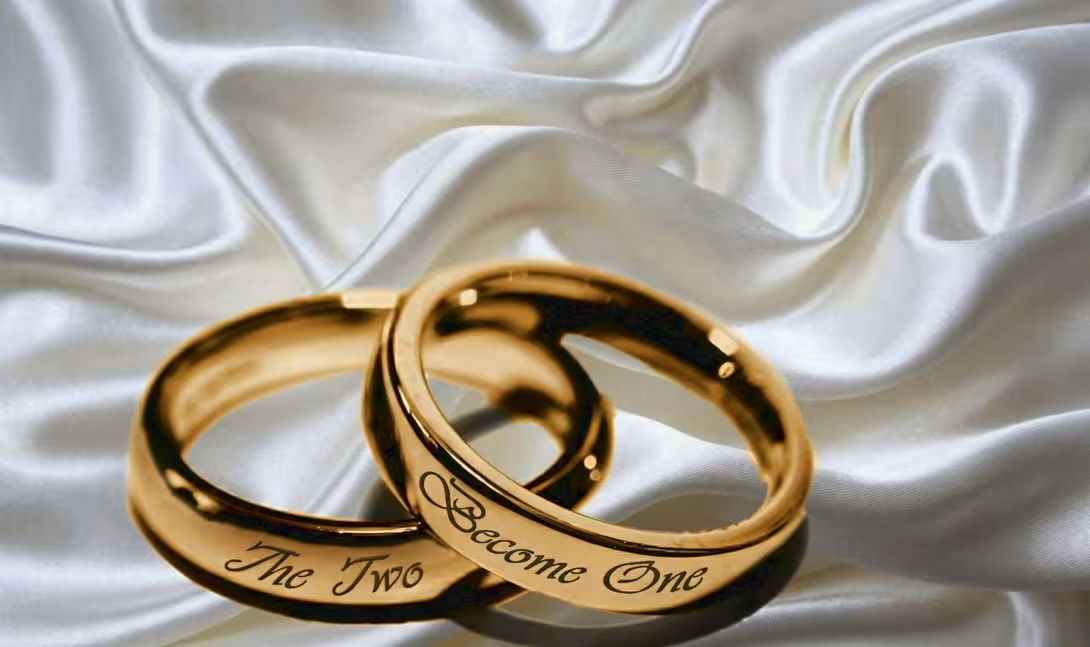
In a world deafened by the fanfare of the 'Big Fat Wedding', history’s most enduring romances whisper a different truth: simplicity is the ultimate luxury.
In our contemporary epoch, the wedding ceremony has metamorphosed into a theatre of the absurd. It is an industry measured in carats, guest lists that rival small armies, and destinations that demand a king’s ransom. We have conflated the cacophony of the celebration with the sanctity of the commitment, frequently witnessing the paradox where the most ostentatious nuptials precede the most fragile unions. Yet, if we turn the pages of history, a profound counter-narrative emerges: the most indomitable, intellectually vibrant, and deeply affectionate partnerships often began not with a spectacle, but with a quiet, unadorned vow.
Consider the modern Indian ethos personified by Sudha and Narayana Murthy. In 1978, decades before they would become the titans of India’s tech revolution, they forged a union of startling modesty. Their wedding was a masterclass in fiscal prudence and egalitarian grace, costing a mere ₹800—a sum split evenly between them. There were no cavalcades of elephants or rivers of silk; there was simply a shared understanding. That unassuming ceremony laid the cornerstone for an empire built on values rather than vanity. Theirs is a partnership that has weathered forty-five years, proving that a marriage grounded in reality is infinitely more robust than one floating on debt.
This philosophy of "high thinking, simple living" was not merely a lifestyle but a political statement for India’s second Prime Minister, Lal Bahadur Shastri. In an era where dowry was an entrenched societal expectation, Shastri stood as a bulwark of principle. He firmly rejected material wealth, accepting only a charkha and a few yards of Khadi cloth—symbols of self-reliance. His union with Lalita Devi was defined not by the weight of gold, but by the weight of their shared sacrifice and silent, unwavering support through the turbulent birth of a nation.
Across the continent, in the gaslit streets of 19th-century Paris, two of history’s greatest minds orchestrated a wedding of utilitarian elegance. Marie and Pierre Curie, united by a passion for science, eschewed the trappings of Victorian tradition. Marie famously refused a bridal gown, donning instead a dark blue ensemble that would serve as her laboratory attire for years to come. Their honeymoon was a bicycle tour of the French countryside—a poetic metaphor for their life ahead: moving forward together, powered by their own energy. Their marriage was a meeting of intellects that would go on to share a Nobel Prize, demonstrating that true compatibility thrives in the absence of performative display.
Even within the gilded cage of celebrity, where visibility is often the only currency, some have staged a quiet rebellion. Global icon Dolly Parton, despite her flamboyant public persona, married Carl Dean in a ceremony of absolute secrecy, attended only by her mother and the preacher. Over half a century later, their bond remains unbreakable, insulated from the public eye. Similarly, contemporary Bollywood actors like Yami Gautam and John Abraham have sidestepped the industry’s penchant for voyeuristic extravaganzas, opting for intimate rites that prioritise the sacred over the scenic.
This wisdom is, of course, ancient. The mythological archetype of Savitri and Satyavan reminds us that the profoundest love is born of Tyaga (renunciation). Savitri’s choice to leave the opulence of a palace for a hermitage was not a demotion, but an elevation of the spirit. Her devotion, stripped of material distraction, was potent enough to conquer death itself—a feat no royal treasury could finance.
These narratives serve as a gentle rebuke to the excesses of our time. They remind us that a wedding is merely a commencement, while marriage is the odyssey. When couples strip away the layers of social performance, they are left with the only thing that truly matters: each other. To choose a simple wedding is not an act of compromise; it is an act of confidence. It is a declaration that the couple values their future autonomy and private joy more than the fleeting applause of an audience. As these luminous lives demonstrate, the richest marriages are often those that begin with the simplest of beginnings.
Comments4
This is a truly eloquent…
This is a truly eloquent piece that captures the essence of what marriage ought to be. The juxtaposition of historical figures like the Curies and the Murthys against today's ostentatious wedding culture is striking. It serves as a poignant reminder that the strength of a union lies in shared values, not in the grandeur of the ceremony. The phrase 'simplicity is the ultimate luxury' resonates deeply. In an age of performative celebrations, this essay is a refreshing ode to the quiet dignity of genuine commitment. Brilliantly written.
Thank you so much, sir. This…
Thank you so much, sir. This essay is merely a reflection of your teachings, sir.
A profoundly moving…
A profoundly moving reflection on the true meaning of matrimony. The reference to Savitri and Satyavan was particularly touching, reminding us that the most powerful vows are often the quietest. In a time where weddings often feel like social transactions, this piece beautifully articulates why humility and sacrifice ('Tyaga') are the real foundations of a lasting partnership. It challenges us to look beyond the glitter and find wealth in simplicity. A timeless lesson for modern couples.
Thank you so much for your…
Thank you so much for your kind words, sir!